DARK MOONAUDIO
The Lab

Tested against
the big names.

We put our plugins head-to-head with the ones you'd otherwise buy, from FabFilter, oeksound, Slate and Universal Audio. Same signals, same settings, same meters. Here are the highlights, with both prices side by side.

1,000+hours of design, tuning and testing
6,000+test results logged across the lineup
8 of 8plugins pass pluginval at its strictest level
5plugins tested head-to-head against the industry names
How they're made

Built by people who make records

There are more than 1,000 hours of work in this lineup. Every plugin started as a tool we needed on our own records, and none of them reached the store until it had been through real sessions, head-to-head tests and testers.

Yes, we use AI coding tools to write code. So does most of the software industry: in Stack Overflow's 2025 survey of developers, 84% said they use or plan to use AI tools in their work.

A tool can type code. It can't tell you a compressor feels wrong on a snare, that a resonance cut is too eager on a vocal, or that a drum replacer missed a ghost note. That part is ours: hours of listening, tuning, measuring and rebuilding until the plugin holds up next to the one it's up against.

  1. 01
    Designed in real sessionsEach plugin starts with a problem from one of our own mixes, and it's shaped by ear on real tracks.
  2. 02
    Built and rebuiltEvery change gets its own build number, and every build is checked against the last one.
  3. 03
    Measured against the big namesHead-to-head tests against the plugins below, with matched settings and published losses.
  4. 04
    Put in front of testersBeta testers on Windows and Mac try each release, and their notes change what we build.
  5. 05
    Stress-tested and signedEach plugin on this page passes pluginval at level 10, then it's code-signed for Windows and notarized by Apple.
Head to head

The results, and the price

Where our plugin wins, it's marked. Where the other one has the edge, we say so, and we're working on closing that gap. In most of these tests you get the same results where your ears can tell, for a fraction of the price.

FjordvsFabFilter Pro-Q 4

Dynamic EQ. 43 filter curves in three phase modes, plus delay, distortion, automation and CPU.
Fjord$49.99
Pro-Q 4$249
You save$199
  • ✓
    About a fifth of the delay in Natural Phase1.27 ms vs 6.67 ms. Tighter monitoring while you track.
  • ✓
    Cleaner automationZipper noise while a band sweeps: −118.4 dB vs −90.8 dB.
  • ✓
    Less delay in Linear Phase too8,704 vs 9,216 samples.
  • =
    Same distortion, same clean bypassBoth measure −89.1 dB THD+N, the floor of the test, and both pass audio through untouched with no bands set.
  • =
    Textbook filter shapes on bothBoth follow the classic analog curves closely. FabFilter counts Q differently, so the same Q number gives a wider bell.
  • !
    Where Pro-Q 4 has the edge: CPU in the phase modesNatural Phase 0.25% vs 0.79% of one core. In Zero Latency they tie at 0.09%. We're working on bringing Fjord's numbers down.
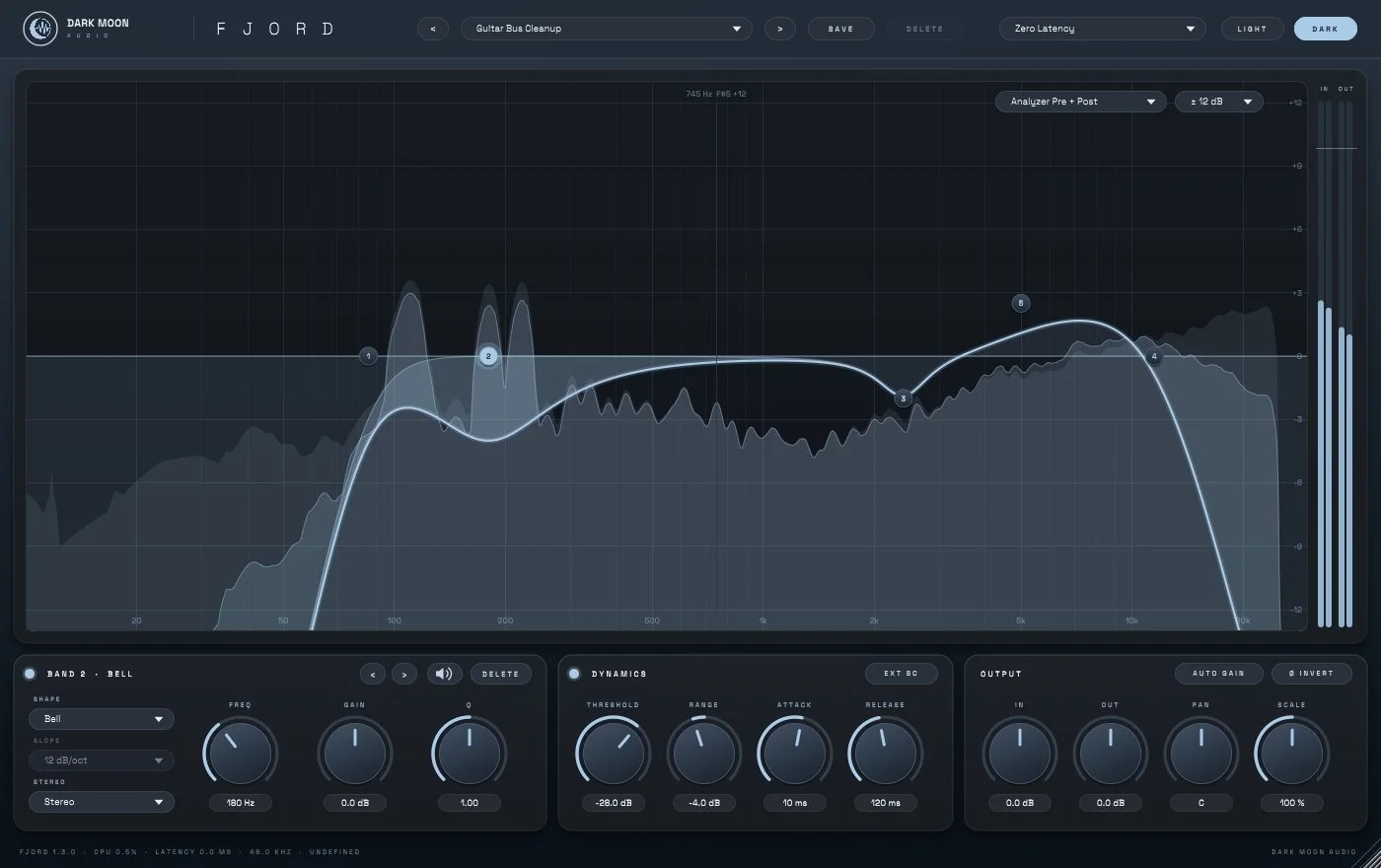
Fjord's interface
Only in Dark Moon
  • Mix assistant. Fjord listens for about six seconds and suggests bands you accept or reject. It never changes the sound by itself.
  • Analog character per band. Clean, Tape, Console, Germanium, Triode or Pentode on each band, with Drive. Pro-Q 4's character is one Clean, Subtle or Warm setting for the whole EQ.
  • A standalone desktop app on Windows and Mac, as well as the plugin.

To be fair: Pro-Q 4 has things Fjord doesn't yet, like Dolby Atmos support up to 9.1.6 and EQ Sketch.
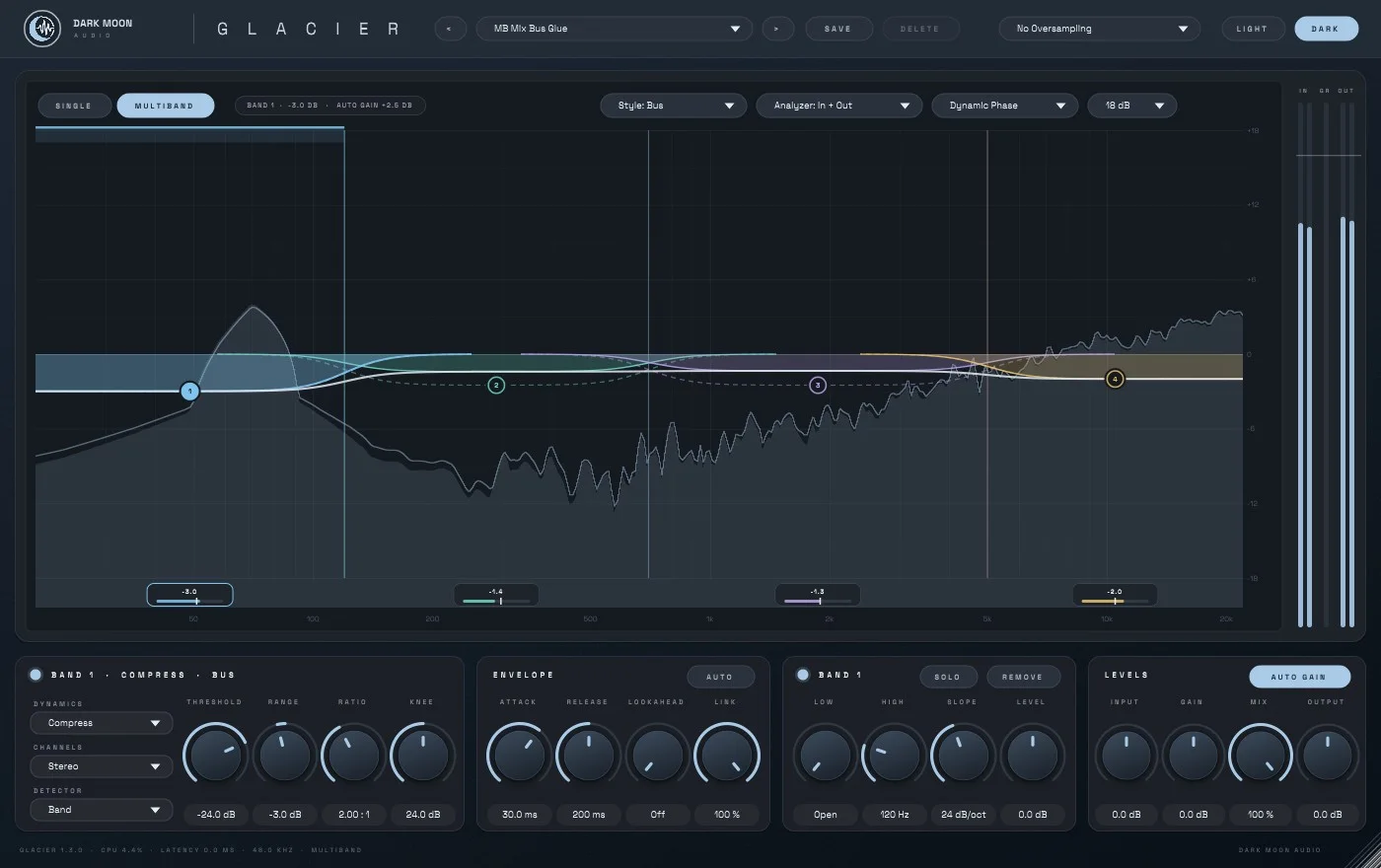
GlaciervsFabFilter Pro-C 3

Compressor. 137 renders across all 8 styles, then 321 more against four vintage classics from Universal Audio.
Glacier$49.99
Pro-C 3$199
You save$149
  • =
    Compresses like Pro-C, style for styleGain reduction within 0.44 dB on average across the styles.
  • ✓
    Lighter on CPU1.27× lighter than Pro-C 3 on average.
  • ✓
    Far less delay with 4× oversampling6 samples vs 40.
  • ✓
    Vintage character for a fraction of the CPUAgainst UAD's 1176LN, LA-2A and Fairchild 670: gain reduction within 0.27 to 0.58 dB, using 4 to 11 times less CPU (for example 0.22% vs 2.42%).
  • !
    Where they have the edgePro-C's lookahead is shorter (480 vs 960 samples), it's lighter in the Punch style, and UAD's SSL Bus Compressor 2 runs lighter than Glacier's (0.12% vs 0.23%). We're working on getting these closer.
Glacier's interface
Only in Dark Moon
  • A full multiband mode in the same plugin. Up to six freely placed bands over a live analyser.
  • Upward expansion to bring quiet detail back up, alongside regular compression and expansion.
  • Auto Setup places the bands for you on the problem areas it hears.
  • A standalone desktop app on Windows and Mac.

To be fair: Pro-C 3 has up to 32× oversampling, MIDI triggering and Dolby Atmos support, which Glacier doesn't.

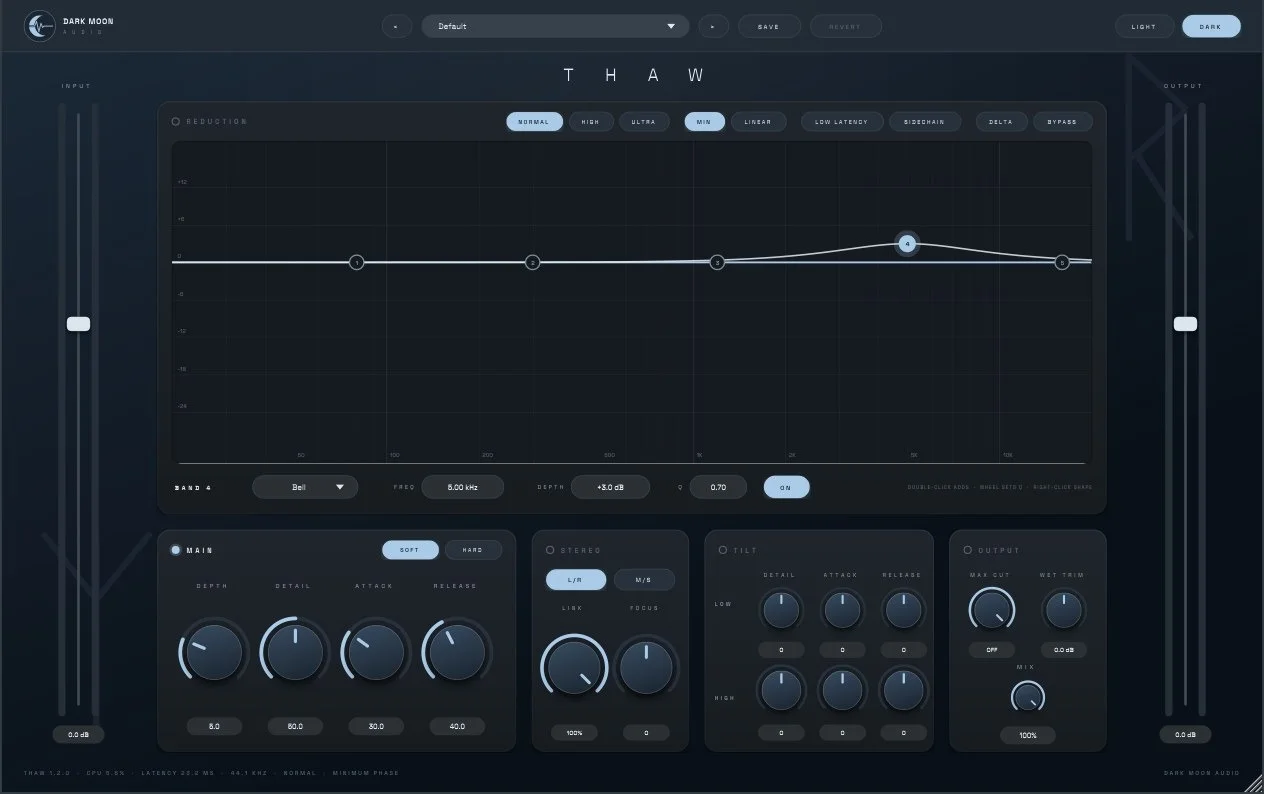
Thawvsoeksound soothe

Resonance suppressor. Tested against soothe2, which oeksound has since replaced with soothe3. Both set to cut the same test resonance by exactly 6 dB, then 21 renders each across ten test signals.
Thaw$34.99
soothe3$259
You save$224
  • ✓
    Half the delay of soothe221.3 ms vs 42.7 ms at 48 kHz, at the same depth.
  • =
    Matched cut, measured, not guessedBoth took exactly −5.98 dB off the test resonance before anything else was compared.
  • !
    Where soothe2 has the edge: CPU1.51% vs 3.25% of one core. We're working on bringing Thaw's CPU down.
Thaw's interface
Listen: Thaw on a guitar
Before and after are level-matched. "What Thaw removed" is turned up about 16 dB so you can hear it.
Only in Dark Moon
  • A standalone desktop app on Windows and Mac. soothe runs only inside a DAW.
  • Light and dark themes you can switch between.
  • Also built into Fjord. Fjord's Resonance section runs Thaw's engine inside the EQ, limited to the range you set.

To be fair: soothe3 adds a zero-latency mode, linear phase and multichannel support up to 9.1.6. We'll be retesting Thaw against it.

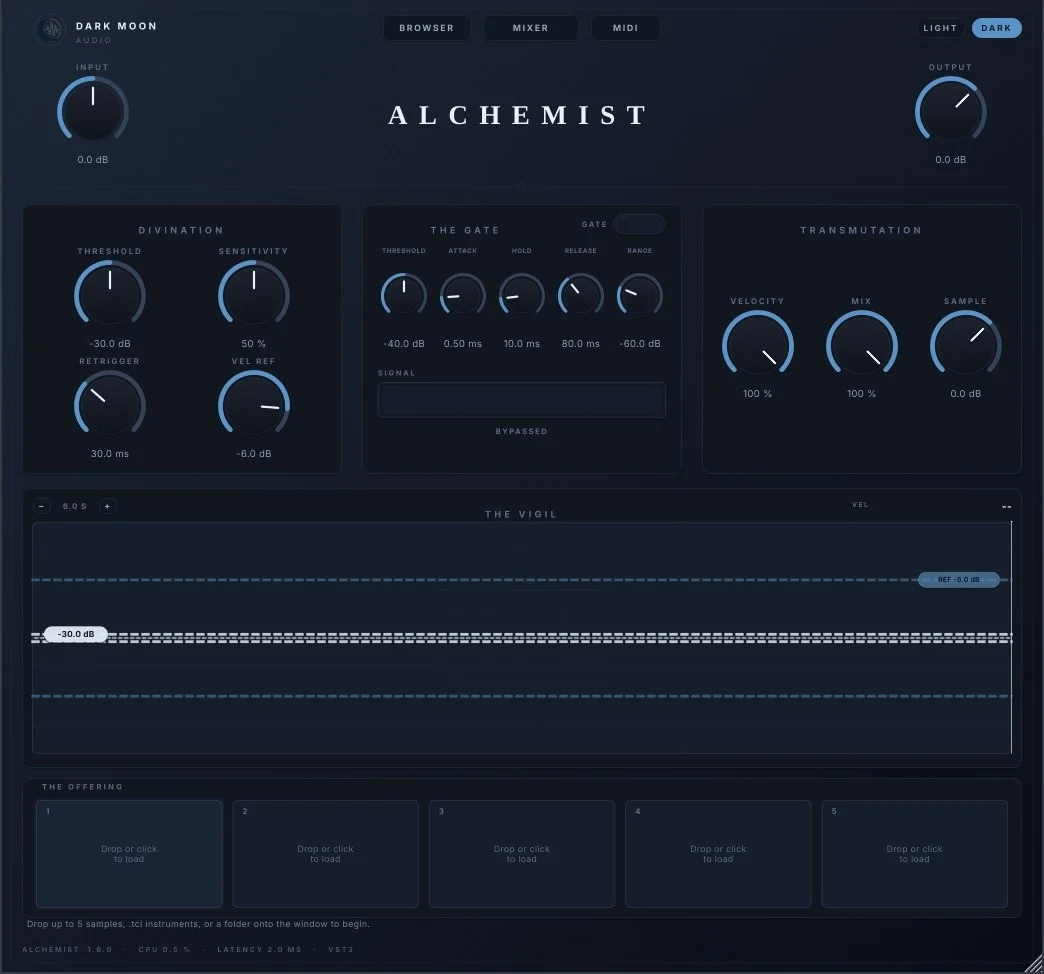
AlchemistvsSlate Trigger 2

Drum replacer. Two shootout rounds, 25 drum instruments and more than 4,300 hit measurements.
Alchemist$49.99
Trigger 2 Platinum$119
You save$69
  • ✓
    Every hit on the fastest test, straight out of the box208 of 208 at default settings. Trigger 2 caught 174.
  • ✓
    Catches more of a dynamic performance42 of 53 hits on a groove full of soft notes at default settings, vs 17. Trigger 2 caught none of the soft notes at its defaults.
  • ✓
    A quarter of the delay5 ms vs 23 ms, and its MIDI out lands on time.
  • ✓
    Same input, same output, every timeTwo identical runs matched to −180 dB. Trigger 2's output changed between runs.
  • !
    Where Trigger 2 has the edgeHand-tuned to its best settings, it caught a few more hits on some tests (61 of 73 vs 38 on fast rolls, 53 vs 50 on ghost notes) and handled background noise better. Alchemist also plays soft notes quieter than they were hit. We're working on its velocity response and on getting these numbers closer.
Alchemist's interface
Only in Dark Moon
  • Ten sample layers per hit. Trigger 2 Platinum layers up to eight.

To be fair: Trigger 2 has a dedicated instrument editor and a live mode as low as 4 ms.

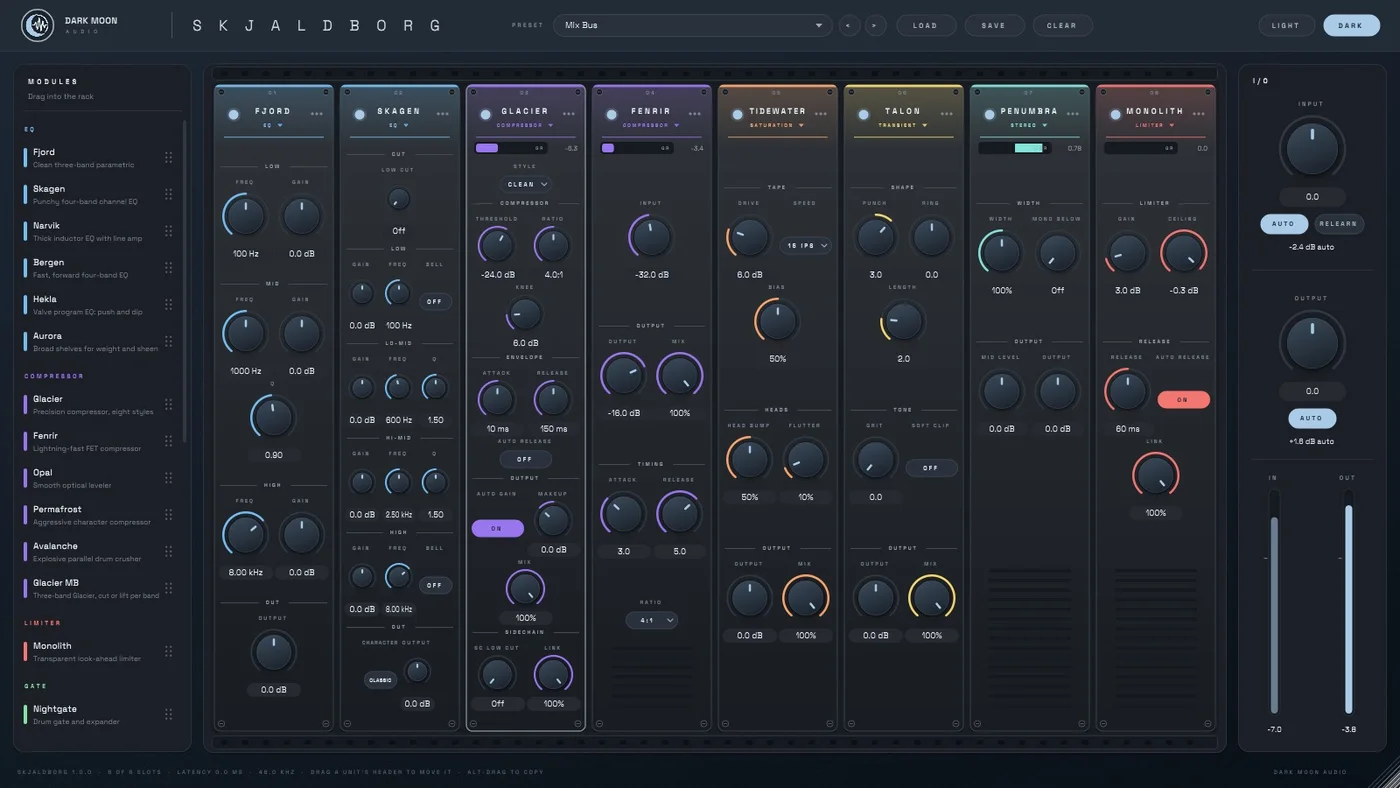
SkjaldborgvsSlate Virtual Mix Rack

Channel rack. 610 module comparisons over three rounds.
Skjaldborg$89.99all 25 modules
VMR$994 modules
  • ✓
    25 modules included, not 4VMR's $99 retail rack comes with two EQs and two compressors. Every other module is sold separately or by subscription.
  • =
    Sounds like the rack you know224 of 253 module comparisons on program material came within 0.75 dB of VMR across the frequency range.
  • !
    Still closing the gapA few modules, mainly the de-esser and Drift, don't match closely yet. We're working on getting them closer.
Skjaldborg's interface
Only in Dark Moon
  • All 25 modules in one license. No module store, no subscription.
  • Ten bays. VMR holds up to eight modules.
  • Automatic input and output level matching, so every A/B is at the same loudness. VMR's gain trimming is manual.
  • A standalone desktop app on Windows and Mac.

To be fair: VMR has an online preset browser and macro controls, which Skjaldborg doesn't.

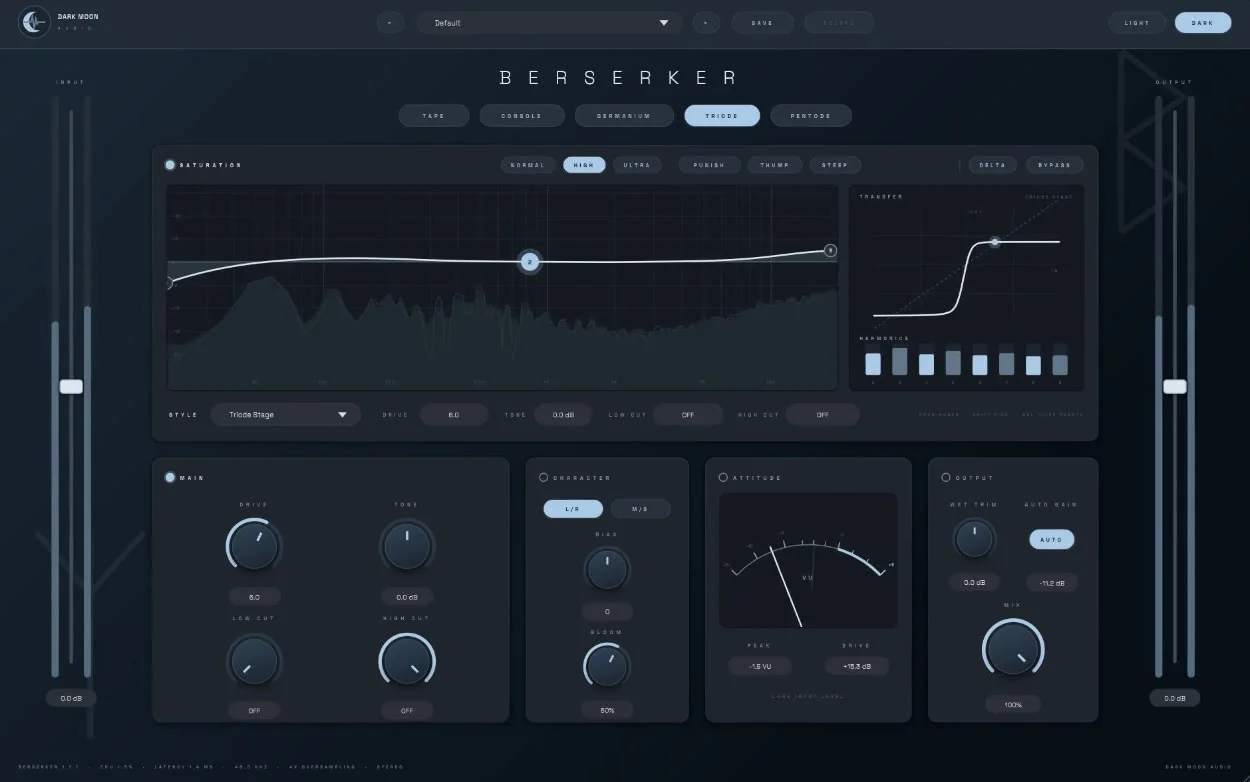
Also on the bench: Berserker went through 114 renders alongside Soundtoys Decapitator. Its write-up is coming.

Under the hood

Built not to crash your session

pluginval is the free, open-source plugin tester from Tracktion. It loads a plugin the way a DAW does and hammers it: opening and closing, automation, saving and reloading, different buffer sizes and sample rates. Level 10 is its strictest setting, and every plugin on this page passes it.

Passed · level 10
Fjord
Passed · level 10
Glacier
Passed · level 10
Thaw
Passed · level 10
Berserker
Passed · level 10
Alchemist
Passed · level 10
Mimir
Passed · level 10
Libra
Passed · level 10
Skjaldborg
Signed & verified for Windows + MacWindows installers are code-signed through Microsoft, so Windows knows they come from us. Mac builds are notarized by Apple. Libra is Windows-only for now.